
Types of Bones
Introduction
Bones are rigid connective tissues that form the framework of the human skeleton. They support the body, protect internal organs, help produce movement and store minerals such as calcium and phosphorus.
Bones differ in shape and structure according to their location and function. Based mainly on their shape, bones are classified into long bones, short bones, flat bones, irregular bones and sesamoid bones.
For example, the femur is a long bone that supports body weight, while the flat bones of the skull protect the brain.
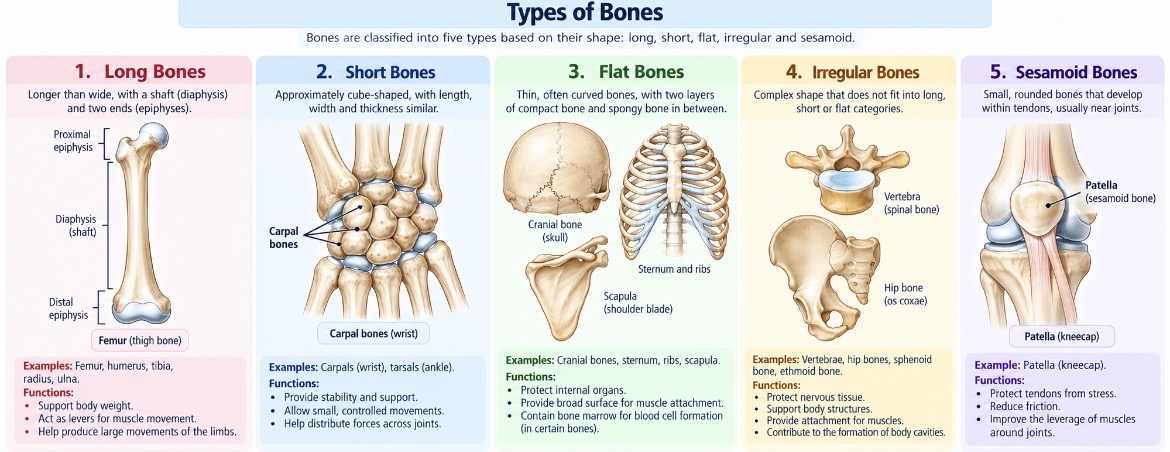
1. Long Bones
Long bones are bones whose length is greater than their width. They typically consist of a central shaft called the diaphysis and two expanded ends called the epiphyses.
The shaft contains a medullary cavity, which commonly contains bone marrow. The ends are involved in forming joints with neighbouring bones.
Examples:
Femur (thigh bone)
Humerus (upper arm bone)
Tibia (shin bone)
Radius and ulna (forearm bones)
Functions:
Support body weight.
Act as levers for muscle movement.
Help produce large movements of the limbs.
Real-life example: The femur supports much of the body's weight during standing and walking.
2. Short Bones
Short bones are approximately cube-shaped, with their length, width and thickness being relatively similar. They contain mostly spongy bone surrounded by a thin layer of compact bone.
Examples:
Carpals of the wrist
Tarsals of the ankle
Functions:
Provide stability and support.
Allow small, controlled movements.
Help distribute forces across joints.
Real-life example: The carpal bones help stabilize the wrist while allowing movements of the hand.
3. Flat Bones
Flat bones are thin, often curved bones that provide protection and broad surfaces for muscle attachment. They commonly consist of two layers of compact bone with spongy bone between them.
Examples:
Cranial bones of the skull
Sternum
Ribs
Scapula
Functions:
Protect internal organs.
Provide attachment sites for muscles.
Contain bone marrow involved in blood cell formation in certain bones.
Real-life example: The ribs and sternum help protect the heart and lungs.
4. Irregular Bones
Irregular bones have complex shapes that do not fit into the long, short or flat categories. Their structure varies according to their specialized functions.
Examples:
Vertebrae
Hip bones
Sphenoid bone
Ethmoid bone
Functions:
Protect nervous tissue.
Support body structures.
Provide attachment sites for muscles.
Contribute to the formation of body cavities.
Real-life example: Vertebrae protect the spinal cord and help support the trunk.
5. Sesamoid Bones
Sesamoid bones are small bones that develop within certain tendons, commonly near joints. They help protect tendons and can improve the mechanical action of muscles.
Example:
- Patella (kneecap)
Functions:
Protect tendons from stress.
Reduce friction in certain locations.
Improve the leverage of muscles around joints.
Real-life example: The patella helps improve the leverage of the quadriceps muscle during knee extension, such as when straightening the leg.
Comparison of Bone Types
Type | Main Feature | Examples | Main Function |
|---|---|---|---|
Long | Longer than wide | Femur, humerus | Support and movement |
Short | Approximately cube-shaped | Carpals, tarsals | Stability and controlled movement |
Flat | Thin and often curved | Skull bones, ribs, sternum | Protection and muscle attachment |
Irregular | Complex shape | Vertebrae, hip bones | Support and protection |
Sesamoid | Develops within a tendon | Patella | Protects tendons and improves leverage |
Important Note
Bone classification is based primarily on shape, not simply on size. For example, the patella is classified as a sesamoid bone even though it is relatively small, because it develops within a tendon.
Key Concepts
Bones are classified by shape into five major types.
Long bones support weight and act as levers.
Short bones provide stability and controlled movement.
Flat bones protect organs and provide muscle attachment.
Irregular bones have specialized shapes and functions.
Sesamoid bones develop within tendons and improve mechanical efficiency.
In summary, the shape of a bone is closely related to its function. Understanding the five types of bones helps explain how the skeleton provides support, protection, stability and movement.