
Introduction
Epithelial tissue is a specialized tissue that covers the external surface of the body, lines internal cavities and organs, and forms many glands. Its cells are closely packed together, with very little space between adjacent cells.
The arrangement and shape of epithelial cells are closely related to the function performed by the tissue. For example, thin epithelial cells allow rapid exchange of substances, while multiple layers provide greater protection.
General Structure of Epithelial Tissue
Epithelial cells are arranged closely together to form a continuous sheet. The tissue rests on a thin supporting layer called the basement membrane, which separates the epithelium from the underlying connective tissue.
Epithelial tissue generally has very little extracellular matrix between its cells and does not contain its own blood vessels. Nutrients reach epithelial cells by diffusion from blood vessels present in the underlying connective tissue.
Epithelial cells also show polarity, meaning that their upper surface and lower surface have different structural and functional characteristics.
Classification of Epithelial Tissue
Epithelial tissue is mainly classified according to:
Number of cell layers
Shape of the cells
Based on Number of Layers
Simple epithelium consists of a single layer of cells. Because all cells are in direct contact with the basement membrane, it is generally suited for functions such as absorption, secretion and exchange.
Stratified epithelium consists of two or more layers of cells. It mainly provides protection against mechanical stress and other harmful influences.
Based on Cell Shape
The major cell shapes are:
Squamous cells are thin and flat. They are suitable for rapid diffusion and filtration.
Cuboidal cells are approximately cube-shaped and commonly perform absorptive and secretory functions.
Columnar cells are taller than they are wide and are commonly involved in absorption and secretion.
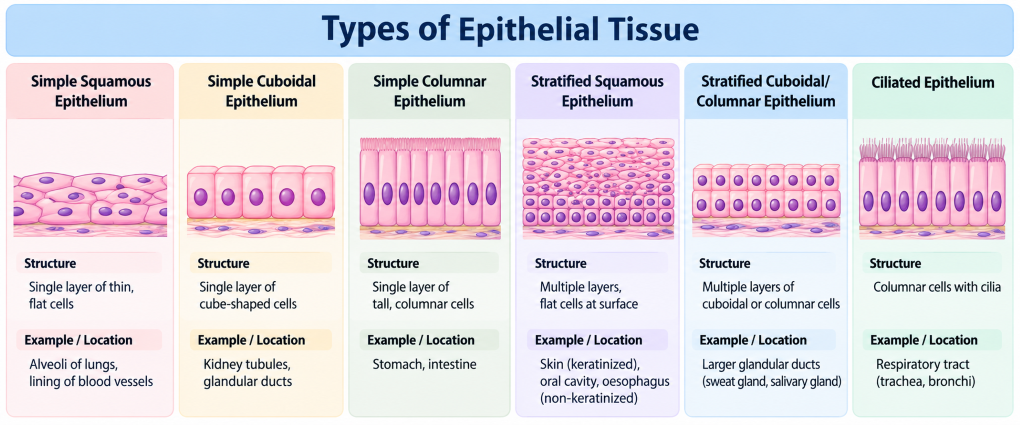
Simple Epithelial Tissue
Simple Squamous Epithelium
Simple squamous epithelium consists of a single layer of thin, flat cells. Its thin structure allows substances to pass across it easily.
It is found in areas such as the alveoli of the lungs, lining of blood vessels and serous membranes.
Its major functions include diffusion, filtration and exchange of substances.
Simple Cuboidal Epithelium
Simple cuboidal epithelium consists of a single layer of cube-shaped cells. The cells commonly have centrally located nuclei.
It is found in structures such as the kidney tubules and some glandular ducts.
Its main functions are absorption and secretion.
Simple Columnar Epithelium
Simple columnar epithelium consists of a single layer of tall, column-shaped cells. Some forms contain goblet cells, which secrete mucus.
It commonly lines parts of the gastrointestinal tract, where it performs absorption and secretion.
Stratified Epithelial Tissue
Stratified epithelium contains multiple layers of cells. The deepest layer is attached to the basement membrane, while the surface layers face the external environment or the lumen.
Because of its multiple layers, stratified epithelium is particularly important for protection.
Stratified Squamous Epithelium
Stratified squamous epithelium has multiple layers, with flattened cells at the surface.
It occurs in two major forms:
Keratinized stratified squamous epithelium forms the outer layer of the skin and provides protection against mechanical injury, dehydration and external environmental factors.
Non-keratinized stratified squamous epithelium lines moist surfaces such as the oral cavity and oesophagus, where protection is required without a keratinized surface.
Stratified Cuboidal and Columnar Epithelium
These types contain multiple layers, with cuboidal or columnar cells at the surface. They are relatively uncommon and are mainly associated with larger glandular ducts.
Specialized Epithelial Tissue
Some epithelial tissues have structural modifications that allow them to perform specialized functions.
Ciliated epithelium contains cilia on the cell surface. Cilia produce coordinated movements that help move substances along the epithelial surface. It is commonly found in parts of the respiratory tract.
Glandular epithelium consists of epithelial cells specialized for secretion. It forms glands that release substances such as mucus, enzymes, hormones or other secretions.
Functions of Epithelial Tissue
Protection: Shields deeper tissues, organs, and skin from physical injury, chemicals, and bacteria.
Secretion: Releases hormones, enzymes, and mucus via specialized glandular cells.
Absorption: Takes in vital nutrients and water, such as in the lining of the small intestine.
Excretion: Removes waste products through structures like the kidneys and sweat glands.
Diffusion and Filtration: Allows the passive passage of gases and small molecules across thin cellular barriers (e.g., in lung air sacs).
Sensation: Contains specialized sensory nerve endings in areas like the nose and taste buds.
The specific function depends on the type and location of the epithelium. For example, skin epithelium mainly provides protection, while intestinal epithelium is specialized for absorption.
Key Concept
Epithelial tissue forms protective coverings and internal linings throughout the body. Its classification depends mainly on the number of cell layers and the shape of its cells, while its structure and location determine its specific function.