
Introduction
Connective tissue is a major type of tissue that supports, connects, binds, protects and separates different structures of the body. Unlike epithelial tissue, whose cells are closely packed, connective tissue generally contains cells distributed within an extracellular matrix.
Connective tissue is found throughout the body. It forms structures such as bone, cartilage, blood, tendons, ligaments and adipose tissue.
For example, tendons connect muscles to bones, ligaments connect bones to other bones, and adipose tissue stores energy and helps insulate the body.
General Structure of Connective Tissue
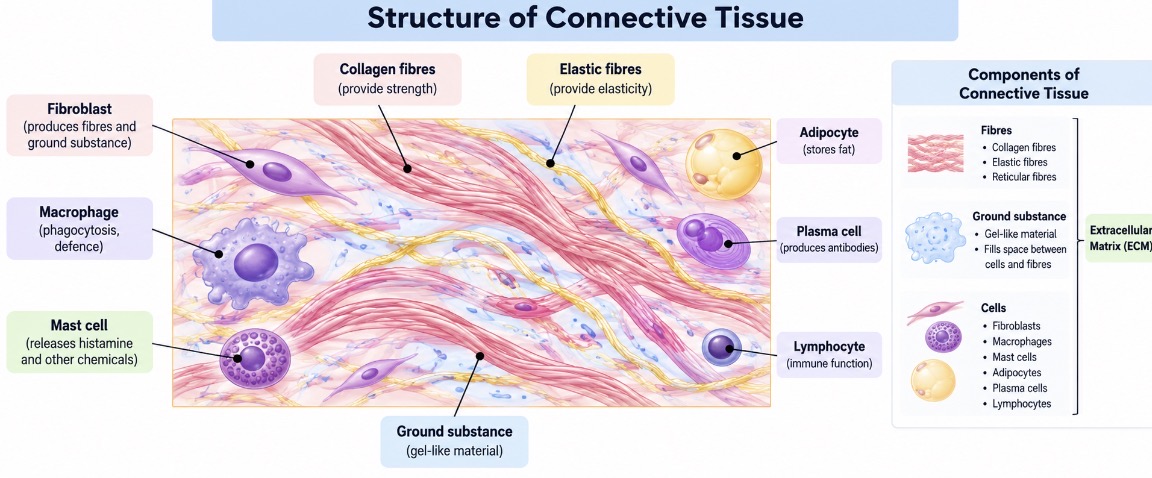
Connective tissue consists mainly of three components:
Cells: Specialized cells that perform functions such as producing fibres, storing fat or defending the body.
Fibres: Protein structures that provide strength, support or elasticity.
Ground substance: The material surrounding cells and fibres that helps support tissues and allows substances to move through the matrix.
The extracellular matrix consists of ground substance and fibres. Its composition varies depending on the type and function of the connective tissue.
Types of Connective Tissue
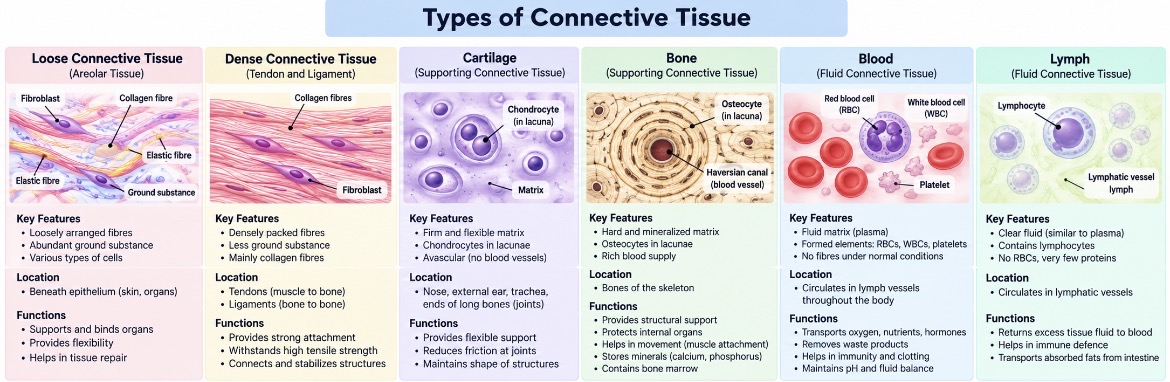
Connective tissue can be broadly classified into connective tissue proper, supporting connective tissue and fluid connective tissue.
1. Connective Tissue Proper
Connective tissue proper includes loose and dense connective tissues.
Loose connective tissue has a relatively flexible matrix and loosely arranged fibres. Areolar tissue supports and connects structures, while adipose tissue stores fat and provides insulation.
Dense connective tissue contains abundant fibres that provide strength. Tendons and ligaments are examples of dense connective tissue.
Real-life example: Tendons help transfer the force produced by muscles to bones, allowing movement.
2. Supporting Connective Tissue
Supporting connective tissue includes cartilage and bone.
Cartilage provides flexible support and helps reduce friction at joints. It is found in structures such as the nose, external ear and articular surfaces of joints.
Bone is a hard, mineralized tissue that supports the body, protects internal organs and provides attachment points for muscles. It also stores minerals and contains bone marrow.
Real-life example: The bones of the skull protect the brain, while cartilage at joint surfaces helps bones move smoothly against one another.
3. Fluid Connective Tissue
Fluid connective tissue includes blood and lymph.
Blood transports oxygen, nutrients, hormones and waste products. It also participates in immune defence and clotting.
Lymph is a fluid that circulates through lymphatic vessels and helps return excess tissue fluid to the bloodstream. It also plays a role in immune function.
Real-life example: Red blood cells carry oxygen from the lungs to body tissues, while white blood cells help defend the body against infections.
Functions of Connective Tissue
Connective tissue performs several essential functions:
Support: Bone and cartilage provide structural support.
Binding and connection: Tendons connect muscles to bones, while ligaments connect bones to one another.
Protection: Bone protects organs such as the brain and heart.
Storage: Adipose tissue stores energy as fat.
Transport: Blood carries gases, nutrients, hormones and waste products.
Defence: Blood cells and other immune cells help protect the body against harmful organisms.
Insulation: Adipose tissue helps reduce heat loss.
Repair: Certain connective tissue cells contribute to wound healing and tissue repair.
Connective Tissue and Its Blood Supply
The blood supply of connective tissue varies by type.
Many connective tissues contain blood vessels, but cartilage is avascular, meaning it lacks its own blood vessels. It receives nutrients mainly through diffusion from surrounding tissues or joint fluid, depending on its location.
Bone, in contrast, has a rich blood supply that supports its growth, maintenance and repair.
Key Concepts
Connective tissue supports, binds, protects and connects body structures.
Its main components are cells, fibres and ground substance.
The extracellular matrix is a defining feature of most connective tissues.
Connective tissue proper includes loose and dense connective tissue.
Cartilage and bone provide supporting structures.
Blood and lymph are fluid connective tissues.
In summary, connective tissue plays a vital role in maintaining the body's structure, transporting substances, storing energy, protecting organs and supporting tissue repair. Its varied structure allows it to perform many different functions throughout the human body.